Stop Telling People to Turn Off Enhanced Pointer Precision
This is gonna be a short one. I didn't really prepare to write this, but it's been on my mind for years and I have been reminded of it again today while researching ways to disable mouse smoothing in Arc Raiders. I see this misconception everywhere I turn when running into technical advice from professional FPS players and their fans. Never from people who've ever worked on a game, of course.
Turning off EPP in your Windows settings is, in 99% of cases, a redundant placebo. Seriously. If you don't believe me, go turn it on right now, and open up your favorite shooter game to see for yourself. If the developers of the game are worth their salt, there will be absolutely zero difference.
If you do notice a real difference... I'm sorry for your loss.
To recap, for those who haven't been told anything other than "turn it off now": Enhanced Pointer Precision is a feature of Microsoft Windows that enables mouse acceleration. The idea behind mouse acceleration is that your sensitivity changes depending on the speed you physically move your mouse, instead of your mousepad being an even 1:1 map of your screen.
The only problem with this feature is that 1. It's enabled by default, which is really weird and 2. There are exactly zero options to customize the acceleration curve without a third party program, and the acceleration curve that Microsoft chose is absolutely atrocious:
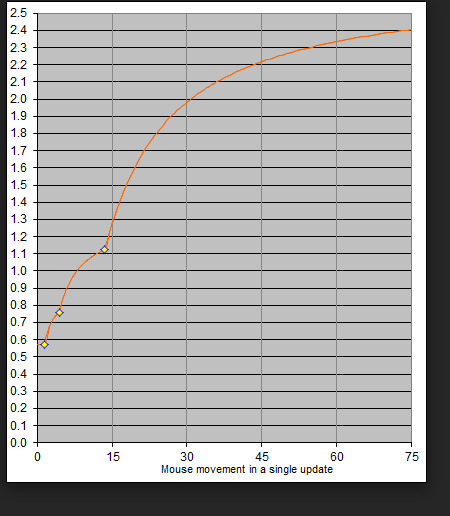
If you're used to leaving it on like I am (for the rare occasion I reluctantly touch a Windows computer in 2025, anyway), this acceleration curve is still not a dealbreaker. I prefer having no acceleration on X, but acceleration enabled on Windows. Only on newer versions of Windows though, because the acceleration curve in older versions made it easy to accidentally lock your pointer on one axis, and this makes microadjustments really hard. I'm just weird I guess.
For some reason though, people seem to believe that this affects the actual mouse inputs at a low level, and not just the pointer. The natural conclusion then is that leaving EPP enabled will ruin your aim in FPS games. Well, not if you're used to the horrible curve it won't, but it doesn't matter. In reality, this is only the case for games that rely on the mouse pointer for their controls. Which is stupid, so most developers over the past twenty five years do not do this anymore.
The standard practice since forever has been to query the most direct input information with as little OS interference as possible. On XOrg for Linux it is the same story: XWarpPointer and anything relying on the pointer position is likely to misbehave if you change the base pointer speed on many window managers, but this rarely affects games and when it does it usually only affects a specific menu.
The only games I can recall off the top of my head that are guilty of relying on the desktop pointer to aim are Quake II, older versions of Minecraft Java Edition, and some of the older Call of Duty titles. Not counting browser games, because playing an FPS in a browser non-casually is gross. Source Engine games have the option to use either raw mouse input or the pointer location, and later games past CS:GO and Portal 2 removed the option in favor of just having raw input on by default.
The bottom line is, the games you care about probably don't control any different if you change your pointer settings.
If you like having EPP off because the pointer on your desktop feels weird with it enabled, then turn it off. I'm not telling you to use it, but it's nowhere near as awful as gamers insist it is. I guarantee most of those people do not understand how their inputs are actually being processed. I'm constantly amazed by the things people who semi-competitively play FPS games believe, and even more by the pseudo-intellectuals dying to defend them because they want to be experts. For instance, I've had people tell me that the reason I'm not an expert at CS is because I play on an ultrawide monitor.
No, you buffoon, I'm not an expert at CS because I don't play twenty hours every day with an organized team! (In the linked example, the stats used against me as a "rebuttal" were for a competitive platform I don't even use, LOL). Video games are for having fun and I like getting good at them within my natural ability, not optimizing the fun out of everything desperately like a self-conscious porn addict on magic pills. If you're bad at the game, you are bad at the game, simple as. Unless you are playing on an actual dinosaur, your computer is not the problem.
There's a lot of half-truths out there that make sense until you analyze them, and you best not analyze them! Some smelly jobless deadbeat might just throw an ad-hom insult your way! Because a lot of these people think that gaming experience translates to computer science experience. It doesn't.